Bocciolatt Cgexplains Again What a Line Segment Is and How a Line Segment Can Be Classified

The geometric definition of a closed line segment: the intersection of all points at or to the right of A with all points at or to the left of B
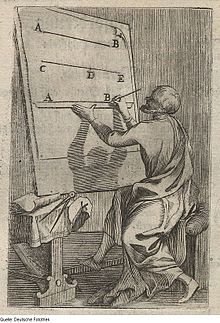
historical image – create a line segment (1699)
In geometry, a line segment is a part of a line that is divisional by ii singled-out terminate points, and contains every point on the line that is between its endpoints. A airtight line segment includes both endpoints, while an open line segment excludes both endpoints; a half-open up line segment includes exactly one of the endpoints. In geometry, a line segment is often denoted using a line above the symbols for the two endpoints (such every bit ).[1]

Examples of line segments include the sides of a triangle or square. More generally, when both of the segment's end points are vertices of a polygon or polyhedron, the line segment is either an edge (of that polygon or polyhedron) if they are adjacent vertices, or a diagonal. When the end points both prevarication on a bend (such equally a circle), a line segment is called a chord (of that bend).
In existent or complex vector spaces [edit]
If V is a vector infinite over or , and 50 is a subset of V, and so L is a line segment if Fifty tin can be parameterized every bit


![{\displaystyle L=\{\mathbf {u} +t\mathbf {v} \mid t\in [0,1]\}}](https://wikimedia.org/api/rest_v1/media/math/render/svg/a7b51ec898964a04faa907aea6fb00df3228c5b0)
for some vectors . In which example, the vectors u and u + five are chosen the finish points of L.

Sometimes, one needs to distinguish between "open" and "closed" line segments. In this case, one would define a closed line segment equally above, and an open line segment every bit a subset L that tin be parametrized equally

for some vectors .
Equivalently, a line segment is the convex hull of two points. Thus, the line segment can be expressed as a convex combination of the segment's ii end points.
In geometry, one might define bespeak B to be between two other points A and C, if the altitude AB added to the distance BC is equal to the distance AC. Thus in , the line segment with endpoints A = (ax , ay ) and C = (cx , cy ) is the following drove of points:


Properties [edit]
- A line segment is a connected, non-empty set.
- If Five is a topological vector space, and so a airtight line segment is a airtight set in V. However, an open up line segment is an open up set in V if and only if V is one-dimensional.
- More generally than above, the concept of a line segment tin exist divers in an ordered geometry.
- A pair of line segments can be any one of the post-obit: intersecting, parallel, skew, or none of these. The terminal possibility is a way that line segments differ from lines: if two nonparallel lines are in the aforementioned Euclidean aeroplane then they must cross each other, but that need not be true of segments.
In proofs [edit]
In an axiomatic treatment of geometry, the notion of betweenness is either assumed to satisfy a certain number of axioms, or divers in terms of an isometry of a line (used as a coordinate system).
Segments play an important function in other theories. For instance, in a convex ready, the segment that joins any two points of the set is contained in the set. This is important because it transforms some of the analysis of convex sets, to the assay of a line segment. The segment add-on postulate can be used to add congruent segment or segments with equal lengths, and consequently substitute other segments into another argument to brand segments congruent.
As a degenerate ellipse [edit]
A line segment can be viewed as a degenerate case of an ellipse, in which the semiminor centrality goes to zero, the foci go to the endpoints, and the eccentricity goes to one. A standard definition of an ellipse is the set of points for which the sum of a point's distances to two foci is a constant; if this constant equals the altitude betwixt the foci, the line segment is the event. A complete orbit of this ellipse traverses the line segment twice. As a degenerate orbit, this is a radial elliptic trajectory.
In other geometric shapes [edit]
In addition to appearing every bit the edges and diagonals of polygons and polyhedra, line segments also announced in numerous other locations relative to other geometric shapes.
Triangles [edit]
Some very oftentimes considered segments in a triangle to include the three altitudes (each perpendicularly connecting a side or its extension to the opposite vertex), the three medians (each connecting a side's midpoint to the opposite vertex), the perpendicular bisectors of the sides (perpendicularly connecting the midpoint of a side to one of the other sides), and the internal bending bisectors (each connecting a vertex to the contrary side). In each instance, there are various equalities relating these segment lengths to others (discussed in the manufactures on the diverse types of segment), too as various inequalities.
Other segments of interest in a triangle include those connecting various triangle centers to each other, most notably the incenter, the circumcenter, the ix-point centre, the centroid and the orthocenter.
Quadrilaterals [edit]
In add-on to the sides and diagonals of a quadrilateral, some important segments are the two bimedians (connecting the midpoints of opposite sides) and the four maltitudes (each perpendicularly connecting one side to the midpoint of the contrary side).
Circles and ellipses [edit]
Any straight line segment connecting two points on a circumvolve or ellipse is called a chord. Whatsoever chord in a circle which has no longer chord is called a diameter, and whatsoever segment connecting the circle's center (the midpoint of a diameter) to a indicate on the circumvolve is called a radius.
In an ellipse, the longest chord, which is also the longest diameter, is called the major axis, and a segment from the midpoint of the major axis (the ellipse'due south middle) to either endpoint of the major centrality is called a semi-major axis. Similarly, the shortest diameter of an ellipse is called the minor axis, and the segment from its midpoint (the ellipse'south eye) to either of its endpoints is chosen a semi-minor axis. The chords of an ellipse which are perpendicular to the major centrality and pass through i of its foci are chosen the latera recta of the ellipse. The interfocal segment connects the two foci.
Directed line segment [edit]
When a line segment is given an orientation (management) it is called a directed line segment. It suggests a translation or displacement (perhaps caused past a strength). The magnitude and direction are indicative of a potential alter. Extending a directed line segment semi-infinitely produces a ray and infinitely in both directions produces a directed line. This suggestion has been absorbed into mathematical physics through the concept of a Euclidean vector.[2] [3] The drove of all directed line segments is normally reduced by making "equivalent" whatever pair having the same length and orientation.[4] This application of an equivalence relation dates from Giusto Bellavitis'south introduction of the concept of equipollence of directed line segments in 1835.
Generalizations [edit]
Analogous to straight line segments above, i tin also define arcs as segments of a curve.
A ball is a line segment in i-dimensional infinite.
Types of line segments [edit]
Chord (geometry)
Diameter
Radius
Run into also [edit]
- Polygonal chain
- Interval (mathematics)
- Line segment intersection, the algorithmic problem of finding intersecting pairs in a collection of line segments
Notes [edit]
- ^ "Line Segment Definition - Math Open up Reference". www.mathopenref.com . Retrieved 2020-09-01 .
- ^ Harry F. Davis & Arthur David Snider (1988) Introduction to Vector Analysis, 5th edition, folio 1, Wm. C. Dark-brown Publishers ISBN 0-697-06814-5
- ^ Matiur Rahman & Isaac Mulolani (2001) Applied Vector Assay, pages 9 & x, CRC Printing ISBN 0-8493-1088-1
- ^ Eutiquio C. Young (1978) Vector and Tensor Analysis, pages ii & three, Marcel Dekker ISBN 0-8247-6671-7
References [edit]
- David Hilbert The Foundations of Geometry. The Open Courtroom Publishing Visitor 1950, p. iv
External links [edit]
- Weisstein, Eric W. "Line segment". MathWorld.
- Line Segment at PlanetMath
- Copying a line segment with compass and straightedge
- Dividing a line segment into N equal parts with compass and straightedge Animated demonstration
This article incorporates material from Line segment on PlanetMath, which is licensed nether the Creative Commons Attribution/Share-Alike License.
Source: https://en.wikipedia.org/wiki/Line_segment
0 Response to "Bocciolatt Cgexplains Again What a Line Segment Is and How a Line Segment Can Be Classified"
Post a Comment